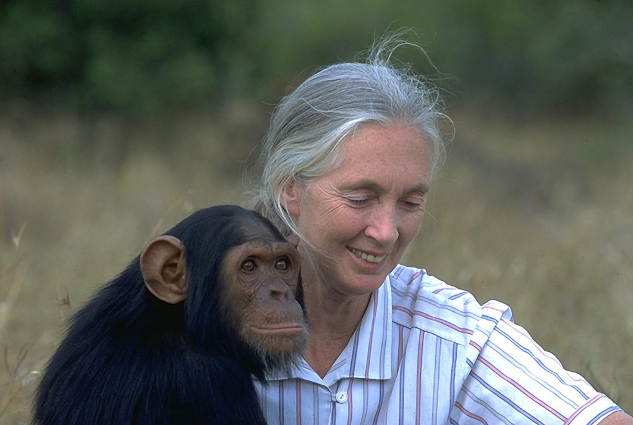
Jane Goodall didn’t just show us chimpanzees. She held up a mirror. By revealing empathy, culture, and family life in our closest relatives, she challenged the story we tell about ourselves—and invited us to live up to it. Here’s why her life’s work remains a blueprint for a more human future.
In This Article
- How Jane Goodall changed the boundary between humans and animals
- What chimpanzee culture reveals about our own social lives
- Why empathy belongs at the center of science and citizenship
- How conservation became Goodall’s moral project—and ours
- Practical ways to carry her legacy forward today
What Jane Goodall Taught Us About Being Human
by Alex Jordan, InnerSelf.comThere are some deaths that feel like a curtain falling on an era. Jane Goodall’s is one of them. Newsrooms reached for standard obituaries—dates, awards, milestones—but the real story is simpler and more demanding: she changed how we look at our relatives, and that changed how we look at ourselves. Goodall walked into Gombe as a young researcher and walked out with a question for all of us: if we are not the only toolmakers, not the only creatures who grieve, share food, reconcile after conflict, and teach the young, then what, precisely, makes us human? And once we answer that, how should we live?
For decades, our culture leaned on a comforting myth: humans on one side, animals on the other, a bright line between. Goodall didn’t erase the line; she smudged it with evidence. She showed us chimps shaping twigs to fish termites, mothers cradling infants with tenderness, communities that fracture and heal. The point was never to shrink humanity; it was to enlarge our circle of care. When you see kinship, cruelty becomes harder to justify. That’s the inconvenient gift of her science.
Breaking the Old Myths
Before Goodall, “man the toolmaker” was a neat bumper sticker for human exceptionalism. Then came the field notes from Gombe: termite fishing, leaf sponges, purpose-built tools adapted to local conditions. Suddenly, “culture” wasn’t just Mozart and microscopes; it included learned behavior passed down through generations in a forest. That discovery didn’t put us down a rung; it forced us to reconsider the ladder itself. We weren’t a species apart—we were a species among.
Her method mattered as much as her findings. Goodall named the chimpanzees. That upset the establishment, which preferred numbers to names, distance to relationship. But names were an ethical declaration: the subjects of study are also subjects of life. The pushback she faced—accusations of sentimentality—missed the point. She wasn’t blurring science with feeling; she was insisting that precision and empathy can coexist. In fact, they make each other stronger. When you recognize a someone instead of a something, you notice more, not less.

Empathy as Method and Message
Empathy, for Goodall, wasn’t a soft add-on; it was an instrument of knowledge. She waited, watched, and listened until the forest revealed its own tempo. That patience is its own kind of discipline. The insights followed not because she projected human traits onto chimpanzees, but because she refused to look away when those traits appeared in them. She built a science that could handle tenderness without losing rigor.
And here’s the larger human lesson: empathy is not just a feeling; it’s a practice that organizes attention. In politics, we often talk as if compassion dulls the mind. Goodall modeled the opposite. Compassion sharpened her questions: Who is this for? What are they trying to do? How does this behavior fit within community life? Those are questions we should ask about our own institutions. If empathy made her a better scientist, it can make us better citizens.
Family, Community, and Power
Look closely at the Gombe stories and you’ll see themes that echo through human neighborhoods: alliances, caregiving, adolescence testing boundaries, dominance challenged by coalitions, reconciliation after violence. No, we are not chimpanzees; we are responsible for our choices in ways they are not. But the parallels are not trivial. They expose how fragile and precious social trust is—how easily it can be broken and how painstakingly it must be rebuilt.
Consider the scenes of food sharing, where elders patiently guide the young; the grooming that renews bonds after conflict; the protective vigilance of mothers; the politics of status that can turn ugly if not leavened by restraint. When you realize that the forest carries versions of our dramas, superiority melts into solidarity. The lesson is not to excuse our failures by pointing to theirs; it’s to recognize the deep roots of our better angels and water them.
Why Conservation Is a Human Project
Goodall did not stay in the comfort of academic fame. She stepped onto airplanes—endless airplanes—and stitched together a global conversation about responsibility. Science had revealed kinship; ethics demanded action. She argued that conservation is not a luxury concern for the wealthy but a survival strategy for everyone. Forests regulate climates; biodiversity stabilizes systems; dignity for animals reflects and reinforces dignity for people. The link between environmental collapse and human suffering is not theoretical; it’s daily life for communities on the edge of drought or flood.
In this sense, Goodall’s message to the human family was both practical and moral: act locally, connect globally, and measure success by what life can flourish because of your choices. That’s not romanticism; it’s systems thinking with a human face. She understood that people protect what they love and love what they understand. Her genius was helping the world understand, and therefore love, what lives beyond our species line.
Roots & Shoots and the Politics of Hope
When cynicism is fashionable, hope can sound naive. Goodall knew better. Hope, to her, was a discipline—something you do, not just something you feel. Roots & Shoots, the youth program she launched, is a case study in hopeful design: empower at the smallest scale, network across schools and towns, and celebrate concrete actions—planting trees, cleaning rivers, advocating humane treatment. The program doesn’t wait for perfect politics. It builds a culture of competence and care from the ground up.
That philosophy is essential now, in an age when doomscrolling wears people down to the nub. If a woman who spent her life documenting both tenderness and brutality in the forest could still insist on hope, we can at least commit to useful work. Plant a tree. Support a sanctuary. Vote for leaders who treat ecology as infrastructure. Hope is built like anything else—by hands, in community, with repetition.
How to Be More Human
So what, concretely, can we learn from Jane Goodall if we want to be more human—more worthy of the word? Start with attention. She watched before she judged. In our lives, that means delaying outrage long enough to see the person across from us. It means learning the specific before generalizing the abstract. Second, cultivate rituals of repair. The chimpanzee grooming that follows conflict is a reminder: relationships are maintained by small, consistent acts, not grand gestures. In families, teams, and towns, we need our own equivalents of grooming—apologies, check-ins, shared meals, the regular maintenance of trust.
Third, honor elders and nurture the young. Goodall paid attention to lineages—who taught whom, how knowledge moves. Healthy societies do the same. Intergenerational projects—community gardens, mentorship networks, public libraries—are not quaint; they are engines of continuity. Fourth, practice restraint with power. Dominance without accountability leads to fracture; influence with responsibility leads to stability. Whether you run a company, a classroom, or a city council, the forest is whispering the same warning: use power to maintain connection, not to erase it.
Fifth, choose stories that enlarge the circle of care. The way we narrate the world either expands or constricts our moral imagination. Goodall offered a narrative of kinship. We can carry it forward by refusing to reduce opponents to caricatures and animals to resources. Language is a tool; use it like a bridge, not a weapon.
Science with a Human Face
One of Goodall’s quiet revolutions was methodological courage. She had the confidence to violate norms—naming, patient immersion, noninvasive observation—because she trusted that truth would vindicate method. It did. That should embolden our institutions to reward forms of rigor that include the full human toolkit: curiosity, persistence, empathy, and yes, the humility to be changed by what we study. We need schools that measure understanding, not just performance; labs that welcome collaboration across disciplines; media that reports nuance instead of chasing noise. The point is not to sentimentalize science; it is to insist that human capacities like care and wonder are not enemies of accuracy. They are its allies.
There is also a lesson for public life. Imagine if we evaluated policies the way Goodall evaluated behavior: not only by intention but by observed consequences in community life. What strengthens bonds? What erodes them? Which interventions increase the repertoire of cooperation? A humane society, like a healthy chimp troop, depends on feedback loops that reward pro-social behavior and discourage predation. That demands institutions that can see beyond quarterly metrics and electoral cycles.
Grief, Gratitude, and the Work Ahead
Grief, when it is honest, points to value. We grieve Jane Goodall because she taught us that our cousins in the forest are not strangers and that our obligations do not stop at the edge of our species. Gratitude is how we turn grief into action. If you want to honor her, protect a piece of habitat or fund a corridor. Volunteer with a local conservation effort. Support humane science in schools. Bring a child to a sanctuary and let them watch an animal watch them back. That mutual gaze can change a life.
We are not finished products. We are participants in an unfinished story, and Goodall handed us a better script: be attentive, be gentle, be brave enough to keep learning. The forest will not forget us if we refuse to forget the forest. And when the line between human and animal blurs, let it be a prompt to act with more—not less—care. That is how we become more human in a world that needs it.
Music Interlude
About the Author
Alex Jordan is a staff writer for InnerSelf.com
Recommended Books
In the Shadow of Man
Goodall’s classic field narrative from Gombe, accessible and intimate, showing how careful attention reveals a world of relationships we once ignored.
Reason for Hope
A personal, reflective memoir that traces the moral arc of Goodall’s life—from discovery to duty—and explains why hope is a discipline, not a mood.
The Ten Trusts
Co-authored with Marc Bekoff, this book outlines practical principles for living respectfully with the rest of life on Earth.
Article Recap
Jane Goodall blurred the boundary between humans and other animals by documenting empathy, culture, and family life in chimpanzees. Her method—patience, attention, and care—offers a template for science and citizenship. To honor her is to widen our circle of responsibility and act with hope.
#JaneGoodall #Humanity #Empathy #Conservation #Chimpanzees #RootsAndShoots #Gombe #Ethics #Hope